

Free express quote
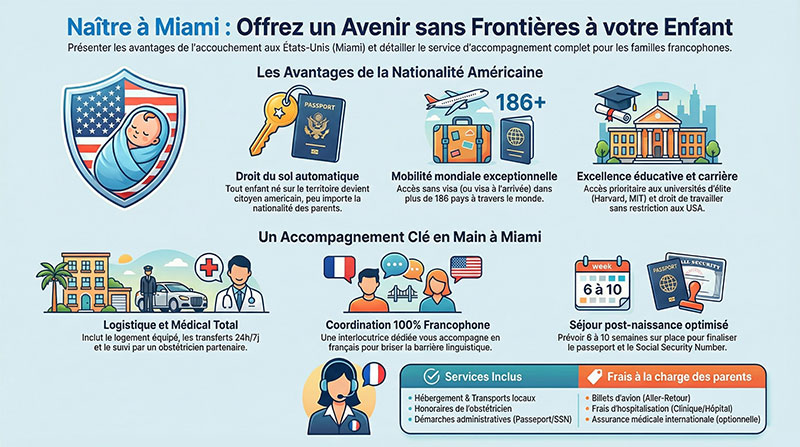
Having a baby in Miami is so much more than giving birth under the Florida sun. For many international families — French, Canadian, European, or South American — Miami has become a top destination for the birth of their child, largely because of the American citizenship automatically granted to all children born on U.S. soil. But planning a birth abroad requires careful preparation, a solid understanding of the American healthcare system, and an early grasp of the administrative steps involved. That is precisely why we have built a comprehensive support package, designed so you can live this adventure with complete peace of mind, without getting lost in the logistical and medical complexity of an overseas stay. This in-depth guide covers everything you need to know — and shows you how we can help at every stage.
Why Choose Miami for Your Baby’s Birth?
Miami is one of the most attractive American cities for international families wishing to give birth in the United States. Several reasons explain this growing appeal.
U.S. birthright citizenship is the primary motivation for many parents. Under the 14th Amendment of the U.S. Constitution, any child born on American soil automatically acquires U.S. citizenship, regardless of their parents’ nationality. An American passport opens remarkable doors: the freedom to work and study in the United States, access to a world-class education and healthcare system, and greatly expanded international mobility.
The quality of medical care is another major advantage. Miami is home to several internationally recognized hospitals, equipped with state-of-the-art maternity wards, advanced neonatal care units, and highly qualified medical staff. Institutions such as Baptist Hospital, Jackson Memorial Hospital, and Nicklaus Children’s Hospital consistently rank among the best in the country.
Cultural and linguistic familiarity also plays a key role. Miami is a deeply bilingual city — English and Spanish — with an active Francophone community and remarkable cultural diversity. Latino, European, and African families often feel right at home, and it is common to find healthcare providers who speak multiple languages.
Finally, the exceptional quality of life — the sunshine, beaches, cuisine, and modern infrastructure — makes the stay around the birth a genuinely enjoyable experience for the whole family.
Choosing the Right Hospital or Birth Center in Miami
Selecting the right facility is a fundamental step. Across Miami and its metropolitan area, several hospitals stand out for their maternity services:
Baptist Health South Florida is one of the most respected hospital systems in the region. Its West Kendall Baptist Hospital and Baptist Hospital of Miami offer high-quality maternity wards with comfortable rooms, experienced physicians, and dedicated breastfeeding support services.
Jackson Memorial Hospital, affiliated with the University of Miami, is one of the largest public hospitals in the country. It provides comprehensive coverage, particularly for high-risk pregnancies, and operates one of the nation’s top Neonatal Intensive Care Units (NICU).
Mount Sinai Medical Center on Miami Beach is especially popular among international families, thanks to its multilingual medical team and personalized approach to care.
Aventura Hospital and Medical Center, located north of Miami, offers a well-regarded maternity ward with modern birthing suites and integrated wellness services.
It is strongly recommended to visit the facility before your due date, meet the medical team, and ask specific questions about their protocols, available delivery options (natural birth, epidural, cesarean section), and policies regarding support persons in the delivery room.
Pre-Departure Logistics: What to Organize
Planning a birth in Miami from abroad requires meticulous organization, ideally started several months in advance.
Choosing the right time to travel is critical. It is generally recommended to fly between the 7th and 8th month of pregnancy (between weeks 28 and 34), to stay within most airlines’ restrictions — many refuse to board pregnant passengers after week 36. Some airlines require a medical certificate from week 28 onward: always check your carrier’s specific conditions before booking.
Obtaining the appropriate U.S. visa is a non-negotiable step for citizens of countries not covered by the Visa Waiver Program (ESTA). Even for nationals of ESTA-eligible countries, traveling with the intention of giving birth is considered an abuse of the program and can result in denial of entry. It is therefore advisable to apply for a tourist visa (B-2) through your country’s U.S. embassy, being upfront about your intentions with consular authorities.
Finding suitable accommodation in Miami is another priority. You will need a fully equipped, accessible, and comfortable apartment or house for several weeks. The neighborhoods of Brickell, Coral Gables, Aventura, and Sunny Isles Beach are particularly popular among international families.
Taking out international health insurance is absolutely essential. Childbirth costs in the United States are extremely high: an uncomplicated vaginal delivery can cost between $10,000 and $30,000, while a cesarean section can exceed $50,000. A solid international maternity insurance policy, taken out before or at the very beginning of pregnancy, is the key to avoiding catastrophic out-of-pocket expenses.
Administrative Steps After the Birth
As soon as your baby is born in Miami, a series of administrative procedures kicks in — both in the United States and in your home country.
Birth registration is handled automatically by the hospital, which reports the birth to the Florida Bureau of Vital Statistics. An official American birth certificate will be issued to you in the weeks following delivery. This document is fundamental: it is proof of your child’s U.S. citizenship.
The U.S. passport can be applied for shortly after the birth. Armed with the birth certificate, you can submit a passport application for your child at an authorized post office or passport acceptance facility. This passport allows your child to travel and assert their American nationality anywhere in the world.
The Social Security Number (SSN) is often offered directly at the hospital right after birth. This number is essential for every aspect of your child’s future life in the United States — taxes, employment, social services, and more. It is highly recommended to obtain it before leaving the country.
Declaring the birth at your home country’s embassy or consulate must be done as soon as possible. A child born abroad to foreign parents must generally be registered with their country’s consulate to obtain the corresponding birth certificate and passport. Most countries accept dual nationality, but it is wise to verify the specific rules applicable in your situation.
Our Support Package for Your Birth in Miami
Organizing a birth abroad involves a multitude of decisions and procedures that can quickly become overwhelming — especially when you are pregnant and far from home. That is why we have developed a comprehensive support offer, designed to cover the essential logistical and medical aspects of your stay, so you can focus on what truly matters: your health and the arrival of your baby.
What Is Included in Our Package
Accommodation is fully taken care of. We select a comfortable home for you, adapted to a woman in late pregnancy and then to a return from the hospital with a newborn: a fully equipped apartment, well located, accessible, in a safe Miami neighborhood. You don’t need to spend hours comparing listings or wondering whether the place will really meet your needs — we handle it.
Local transfers are also included. From the moment you land in Miami, we coordinate your transportation: airport pick-up, rides to medical appointments, and of course the transfer to the clinic or hospital on the big day — with no stress over logistics, even in the middle of the night or in an emergency.
Medications prescribed as part of your prenatal care and delivery are covered by our package. Prescriptions, preventive treatments, or supplements recommended by your doctor — you won’t need to advance these costs or navigate the American pharmacy system on your own.
Physician fees and medical consultations form the heart of our service. We coordinate the selection of your obstetrician, schedule the necessary prenatal visits from the moment you arrive, and cover the physician’s fees directly. You receive high-quality medical monitoring from a professional selected for their expertise and experience with international patients.
What Is Not Included
In the interest of full transparency, two significant cost items remain your responsibility:
Your airline tickets (round trip from your home country) are not included in our package. We recommend booking early to secure the best fares and verifying your airline’s policies regarding travel in late pregnancy.
Clinic or hospital fees — including room and board, the delivery suite, the hospital medical team’s fees, neonatal care, and related costs — are also your responsibility. These costs vary depending on the facility and type of delivery. We will guide you toward the best-suited establishments for your situation and budget, and advise you on the international insurance coverage needed to handle these hospital expenses under the best possible conditions.
Why Trust Our Support?
Our team has an in-depth knowledge of Miami’s medical landscape, its leading facilities, and the administrative procedures specific to births by foreign nationals. We have accompanied many families from Europe, Africa, and Latin America, and we understand that every birth project is unique. That is why we tailor our support to your personal situation, remaining available and responsive throughout your entire stay.
FAQ – All Your Questions About Having a Baby in Miami
1. Is it legal to come to the United States to give birth?
Yes, giving birth in the United States is legal for foreign nationals. No American law prohibits pregnant women from traveling to U.S. territory and delivering there. However, immigration authorities may deny entry to someone they suspect of intending to exploit birthright citizenship. It is therefore important to be well prepared, transparent, and to have sufficient financial resources available to cover medical expenses.
2. Will my child born in Miami automatically be an American citizen?
Yes. Under the 14th Amendment of the U.S. Constitution, any child born on American soil is automatically a U.S. citizen, regardless of their parents’ nationality. This rule applies even if the parents are undocumented on U.S. territory.
3. How much does giving birth in Miami cost?
Costs vary depending on the type of delivery and the facility. An uncomplicated vaginal delivery in a private hospital can cost between $10,000 and $25,000, or more. A cesarean section can range from $20,000 to $50,000. These figures do not include prenatal follow-up costs, prior medical consultations, potential complications, or neonatal care. International insurance coverage is therefore essential.
4. How far along in the pregnancy can you fly to Miami?
Most airlines allow pregnant women to fly up to week 36 (for single pregnancies) and up to week 32 (for multiple pregnancies). From around week 28, a medical certificate may be required. We recommend traveling between weeks 28 and 34 to allow enough time to settle in before the birth and to remain long enough afterward to complete all the necessary administrative steps.
5. What visa is needed to come to Miami to give birth?
For nationals of ESTA-eligible countries, it is technically possible to enter without a visa. However, if a border agent suspects you are traveling to give birth, they may deny entry. For greater security, it is recommended to apply for a tourist visa (B-2) at your country’s U.S. embassy, openly declaring your intention. This significantly reduces the risk of being turned away at the border.
6. How do you choose an OB/GYN in Miami?
It is best to choose an obstetrician-gynecologist affiliated with the hospital where you plan to deliver. You can search hospital online directories, ask for recommendations from other expat mothers, or work with a specialized agency. Some physicians speak French, Spanish, or other languages, which greatly facilitates communication. Plan at least one prenatal consultation as soon as you arrive in Miami.
7. Can you use a midwife or give birth at home in Miami?
Florida allows certified midwives (Certified Nurse-Midwives and Certified Professional Midwives) to attend deliveries, including home births and birth center births. However, for women traveling from abroad, a hospital birth is strongly recommended for both medical safety and administrative simplicity.
8. How long should you stay in Miami after the birth?
It is generally recommended to stay for a minimum of 6 to 8 weeks after delivery. This window allows time to receive the American birth certificate (issued 2 to 4 weeks after birth), apply for the baby’s U.S. passport, obtain the Social Security Number, and make sure your newborn is healthy enough to travel. Flying with a newborn is medically feasible, but waiting at least 4 to 6 weeks is best practice.
9. How do you obtain the American birth certificate?
The hospital handles the birth registration with the Florida Bureau of Vital Statistics. The official birth certificate will then be mailed to you or can be collected in person. Allow an average of 2 to 4 weeks. It is strongly advised to order several certified copies, as this document will be required for all subsequent procedures.
10. How do you obtain your baby’s U.S. passport in Miami?
Once you have the birth certificate, you can submit a U.S. passport application at an authorized post office or passport acceptance facility. You will need the original birth certificate, a passport photo of the baby, your own identity documents, and a completed DS-11 form. Standard processing takes 6 to 8 weeks, but an expedited option (2 to 3 weeks) is available for an additional fee.
11. Do you need to register the child at your home country’s consulate?
Yes, in virtually all cases, you must register your child’s birth with your home country’s consulate or embassy in Miami (or in Washington D.C.). This step establishes the child’s home country nationality and allows you to obtain the corresponding documents (foreign birth certificate, passport). Most countries accept dual nationality, but always verify the specific rules for your country.
12. Can a child born in Miami hold dual nationality?
In most cases, yes. The United States does not require its citizens to renounce other nationalities, and most countries — including France and many other European nations — recognize dual nationality. Your child will therefore be able to hold both a U.S. passport and a passport from their other country of nationality, giving them exceptional freedom of movement and residence across the globe.
13. What are the risks or drawbacks of this approach?
The main risks include denial of entry into the United States (particularly via ESTA), uncovered medical expenses in the case of insufficient insurance, medical complications far from home, and administrative difficulties due to the distance. The emotional stress of giving birth far from family and one’s support network is also a factor not to be underestimated. Serious preparation, a realistic budget, and professional support are the best ways to minimize these risks.
14. What exactly does your support package include?
Our offer covers the key logistical and medical costs of your stay in Miami. Included are: accommodation (a comfortable, fully equipped apartment, well located for the duration of your stay), local transfers (airport, medical appointments, hospital), medications prescribed as part of your prenatal care, and physician fees for your prenatal and postnatal medical consultations. Your airline tickets and direct hospital or clinic fees (room and board, delivery suite, hospital medical staff, etc.) are not included and remain your responsibility. We will guide you toward appropriate international insurance to cover these hospital costs under the best possible conditions.
15. What is the best time of year to plan a stay in Miami?
Miami has a tropical climate with two main seasons: the dry season (November to April), which is more pleasant, and the wet season (May to October), marked by intense heat, high humidity, and hurricane risk. If you have flexibility in your timeline, planning your stay outside of the June-to-October window will make day-to-day life considerably more comfortable — especially in the final weeks of pregnancy.
Conclusion
Planning your baby’s birth in Miami is an ambitious project — but entirely achievable with the right support. Between the quality of medical care, the advantages of U.S. birthright citizenship, and the exceptional quality of life the city offers, Miami provides ideal conditions for welcoming a new member of your family. Our package has been designed to remove the main logistical and medical obstacles, allowing you to experience this journey with true peace of mind: turnkey accommodation, coordinated transfers, medications, and medical consultations all taken care of. Your only job? Take care of yourself and savor every moment before the big arrival. Contact us to discuss your project and receive personalized support tailored to your situation and your timeline.
A Propos De l'Auteur

Je m'appelle Ayline. Je suis journaliste et rédactrice du blog Medespoir Esthétique Turquie. J'ai obtenu un Master 2 en Information et Communication spécialisé santé. J'ai 5 ans d'expérience dans l'écriture sur le web santé et bien-être.
Passionnée par le domaine de l'esthétique médicale depuis longtemps, j'ai créé mon blog il y a 3 ans pour informer et conseiller les personnes intéressées par la chirurgie et médecine esthétique.
Mon objectif est de vulgariser ces sujets parfois complexes, de démystifier certaines idées reçues et d'aider à y voir plus clair parmi l'offre abondante.
Je réalise des articles pédagogiques, je donne mon avis sur les dernières innovations, je compare les offres entre pays, je teste de nouvelles cliniques.
Je publie également régulièrement des portraits détaillés de chirurgiens esthétiques renommés en Turquie, en France et à l'international.
Grâce à mon expérience d'écriture et ma curiosité, je sais rendre mes sujets accessibles à tous tout en gardant un regard critique et bienveillant.
